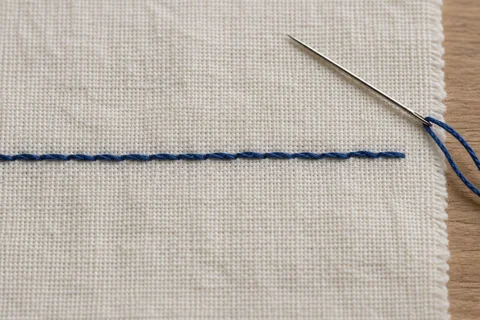
An even running stitch by hand
Running stitch travels alternately above and below the cloth. Even tension matters more than making the stitches tiny.
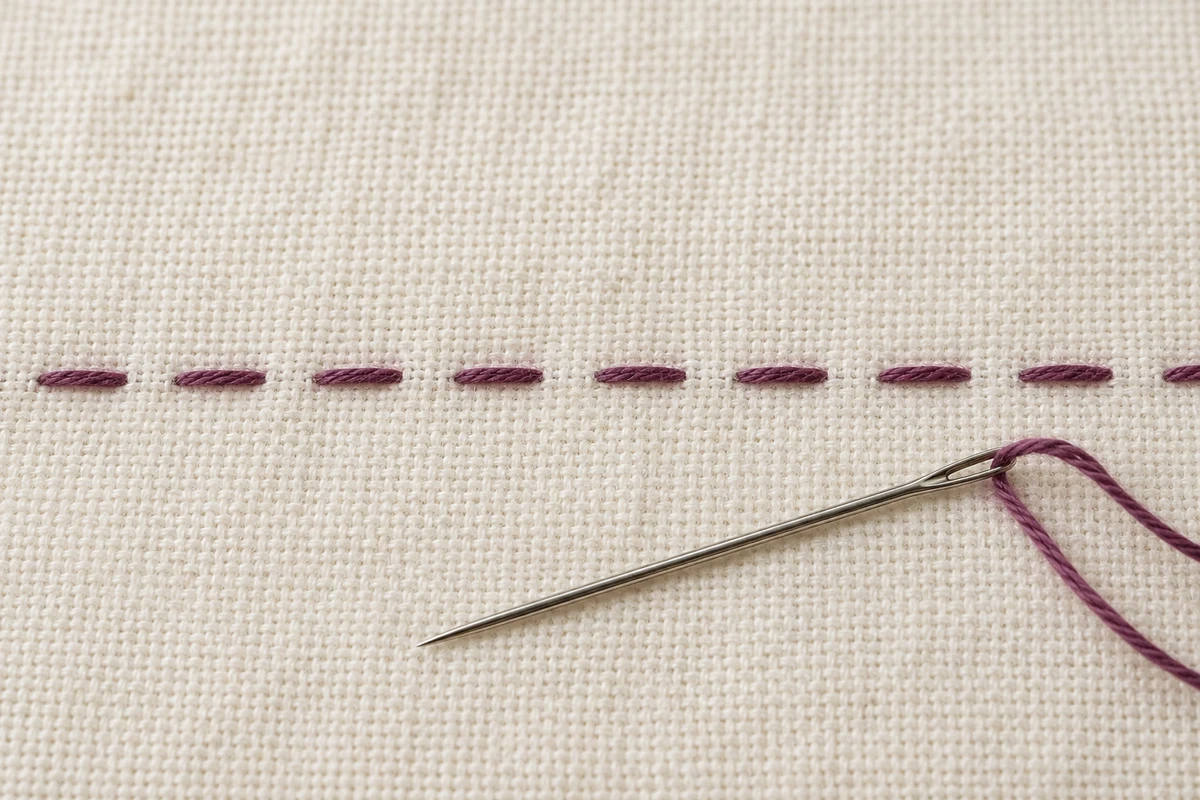
Give yourself a visible practice line
Choose a light-colored piece of stable woven fabric and a contrasting thread. Draw a straight line with a removable marker already tested at the edge. A hand-width of stitching is enough for a first trial. An extremely small scrap is harder to hold and distracts from the needle movement.
Thread a suitable needle and secure the end. Begin with stitches around 3 to 4 mm long rather than trying to make them microscopic. The gaps can be similar in length. This makes consistency easy to see. Finer stitching can follow once the movement feels controlled, without relying on strained counting of individual fabric threads.
Move through the cloth without gathering it
Bring the needle up, then insert it a few millimeters farther along. After another short distance, bring it up again. Pull the thread through until it rests flat, without drawing the fabric together. If you load several stitches onto the needle at once, release the resulting fabric folds completely afterward.
Put the sample flat on the table regularly. A slightly gathered line may look straight in your hand because your fingers stretch it. Waves become clearer when the cloth is unsupported. Loosen recent stitches if necessary before continuing; strong pressing later is not a substitute for suitable thread tension.
Match the stitch to the task
Running stitch works for basting and simple decorative lines. Longer stitches are easier to remove after machine sewing. Shorter ones can join light pieces, but they do not automatically replace a stronger structural seam. Backstitch is often a more appropriate hand stitch for a repair exposed to pulling.
Shorten the stitches around a curve so the line does not become visibly angular. Rotate the cloth instead of twisting your wrist into an uncomfortable position. Secure the thread discreetly at the end. Label the sample with its stitch length and intended use. A loose basting line and a visible decorative line can look different even though they use the same basic movement.