Gift cloths from fabric you already have
A gift cloth needs a suitable size and edges that remain tidy after repeated tying.
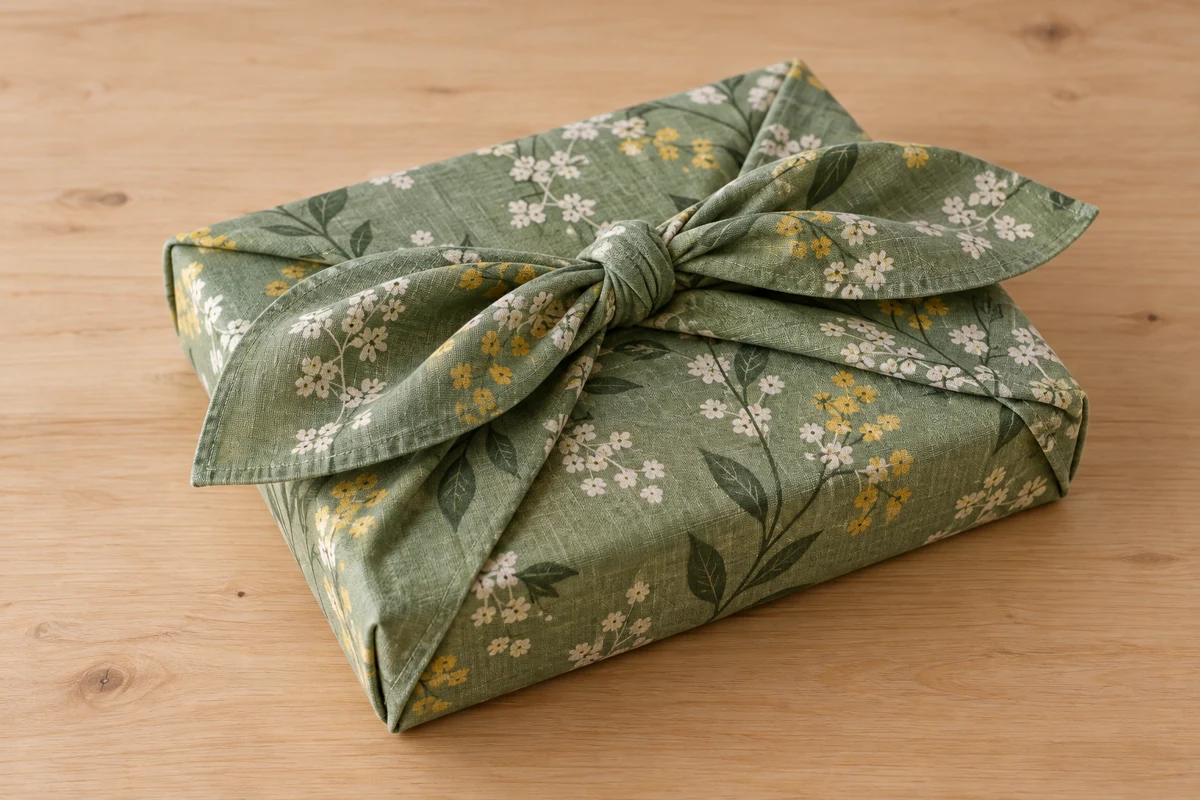
Measure around the actual gift
Place the object diagonally on an existing cloth and bring opposite corners together over it. They need enough extra length for a knot that can be undone, not merely enough to touch. A flat book and a tall box require different amounts of fabric. Try the fold around the real gift before cutting a favorite remnant.
A square around 50 cm across, roughly 20 inches, is a possible starting point for a small box rather than a universal size. To finish at 50 cm with two 1 cm turns on each edge, cut a 54 cm square. If a scrap is smaller, it may make more sense to choose a smaller gift than to add narrow strips just to gain a few centimeters.
Give fragile objects their own protection
Cloth wrapping is not cushioning for breakable objects. Put glass or thin ceramics in appropriate protective packaging first, then wrap that package decoratively. Check whether the knot presses on a lid or projecting handle and move it to a clear area if necessary.
For a book, a clean paper layer can separate the cover from unidentified fabric dyes, although it does not establish archival protection. Remove stray threads and consider rough labels on reused cloth. An old scarf may have an attractive finished edge but a scratchy care tag; keep that tag away from a delicate surface.
Choose fabric that can form a knot
Light cotton, thin linen, or an existing soft scarf is easier to tie than stiff upholstery fabric. Check used textiles for stains, brittle areas, and unstable prints. A pretty pattern does not make fabric with unknown residue suitable for wrapping a clean gift.
Finish raw edges with a narrow double hem. A scarf with sound finished edges can remain as it is. Thick borders affect the knot, so include them in your trial rather than testing only the soft center. Remove every pin and loose thread before placing the gift on the cloth.
Tie it so it can open again
Center the gift diagonally on the square. Bring one pair of opposite corners over it and tie them loosely. Tie the second pair above or beneath the first connection, depending on the object's height and shape. The cloth should hold its position without crushing the box or pressing hard against a delicate surface.
Avoid pulling the knots as tight as possible. Reusable wrapping is more pleasant when it opens without scissors. Slip a small card under the knot instead of taping it to the fabric. If the recipient should keep the cloth, say so briefly; if it is simply for transport, make that clear as well. Repeated use depends on this small practical agreement and a useful size, rather than an environmental slogan printed on the wrapping.