Close a turning gap by hand
Ladder stitch joins two folded edges from the outside, making it useful for closing a turning gap.

Prepare two accurate folds
Turn the opening allowances inward so they continue the existing seam line. Press them first if the fabric permits. Tiny stitches cannot straighten an opening whose two folds were prepared unevenly. Keep stuffing out of the join, where it can leave a visible pale line between otherwise neatly closed edges.
Use a suitable hand needle and a manageable length of thread. Around an arm's length is generally easier to control than a very long strand that twists repeatedly. Knot the end and begin slightly inside the already closed seam so the knot rests between the layers rather than on the visible surface.
Travel inside each folded edge
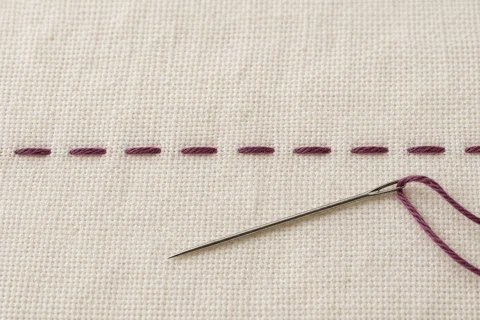
Take a short lengthwise stitch through the fold on one side. Cross directly to the opposite fold and take another small stitch there. The connecting threads initially span the gap like ladder rungs. Most of each stitch sits within the folded edges instead of passing through a large area of the visible face fabric.
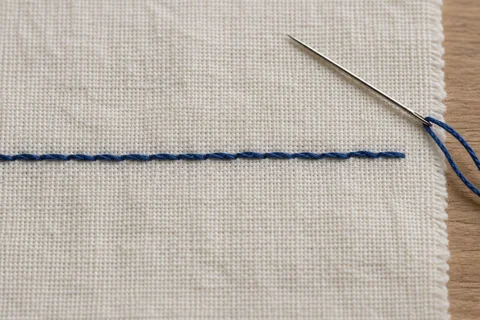
Work several stitches, then draw the thread gently. The folds move together and conceal the crosswise strands. Pulling hard after every individual stitch can create small puckers. Along a straight opening, the folds should meet without one being pushed over the other.
Let the tension reveal the problem
If a wide gap remains, the stitches may sit too far from the folds or the allowances may have been turned in unequally. Check both before increasing tension. An overstuffed cushion may also be pressing against the opening. Remove some filling rather than stretching the thread close to breaking.
At the end, overlap the existing closed seam with a few small stitches. Secure the thread unobtrusively, then pass the needle a short distance between the layers before cutting it. This hides the loose tail. Ladder stitch is intended here as a finishing closure; a heavily loaded joint needs an appropriate structural seam rather than relying solely on an inconspicuous outside connection.