Plan a wipe-clean desk mat
A wipe-clean desk mat needs to suit the desk finish and the work you do, not just the desired dimensions.
Define the working area
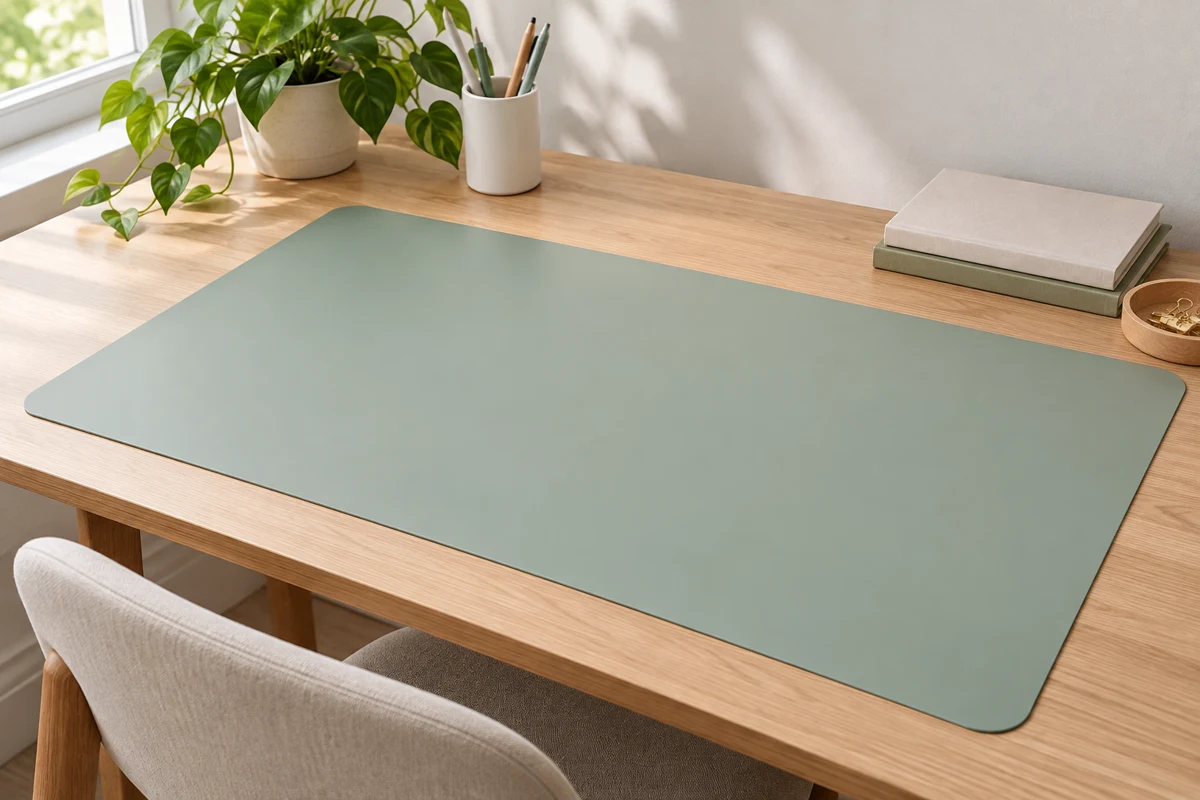
Measure the free space between the keyboard, lamp, and other permanent objects. A mat trapped beneath several heavy items is difficult to lift for cleaning. Make a paper mock-up and move the mouse, notebook, and your forearms as you normally would. This reveals whether a corner catches or an edge falls directly beneath your writing hand.
A defined working zone is often more convenient than covering the entire desk. It leaves cable openings and vulnerable edges accessible. Rounded corners may feel more comfortable, but the selected material must allow a clean curve. Finalize the outline only after the paper shape has spent some time in a useful working position.
Use material intended for the surface
A trimmable product already sold as a desk protector is easier to assess than unidentified plastic film. Read its cleaning, surface-contact, and temperature instructions. Some materials interact poorly with particular finishes. An inconspicuous contact trial may be useful, but it does not override a stated incompatibility.
If placing fabric beneath a transparent protective layer, keep the two removable. Moisture between them needs to be noticed and allowed to dry. Avoid improvised full-surface gluing that could show through or bring adhesive into contact with the desk. Decorative fabric is not a protective cutting mat either.
Cut only as the material permits
Mark the final outline on the intended reverse or an overlaid template. Use a tool that cuts without splintering or leaving sharp broken edges. For thicker plastic, a suitable precut size may be better than forcing a curve with an inappropriate knife. Smooth edges only in a way recommended for that material and remove every loose particle.
Place the mat on the clean, dry desk without taping it down. Check its edges by hand: they should not curl upward or press unpleasantly into your forearm. Try the mouse on the actual surface as well. Smooth or transparent materials do not always track reliably; a separate small mouse pad may be the simplest answer.
Make the underside accessible
Clean the top with a product permitted by the manufacturer. Lift the mat periodically and clean the desk below. Grit and craft fragments can collect between the surfaces and scratch when the mat moves. Let the underside dry fully before replacing it.
Cutting, hot-gluing, and solvent work each need an appropriate protective surface. An ordinary wipe-clean mat is not automatically heat-, blade-, or chemical-resistant. Keep a separate work protector nearby if the desk serves several purposes. That arrangement is easier to maintain than expecting one decorative sheet to tolerate every task.