Make unobtrusive labels for open shelves
Shelf labels help when they can be read from the usual viewing position and changed as the contents change.
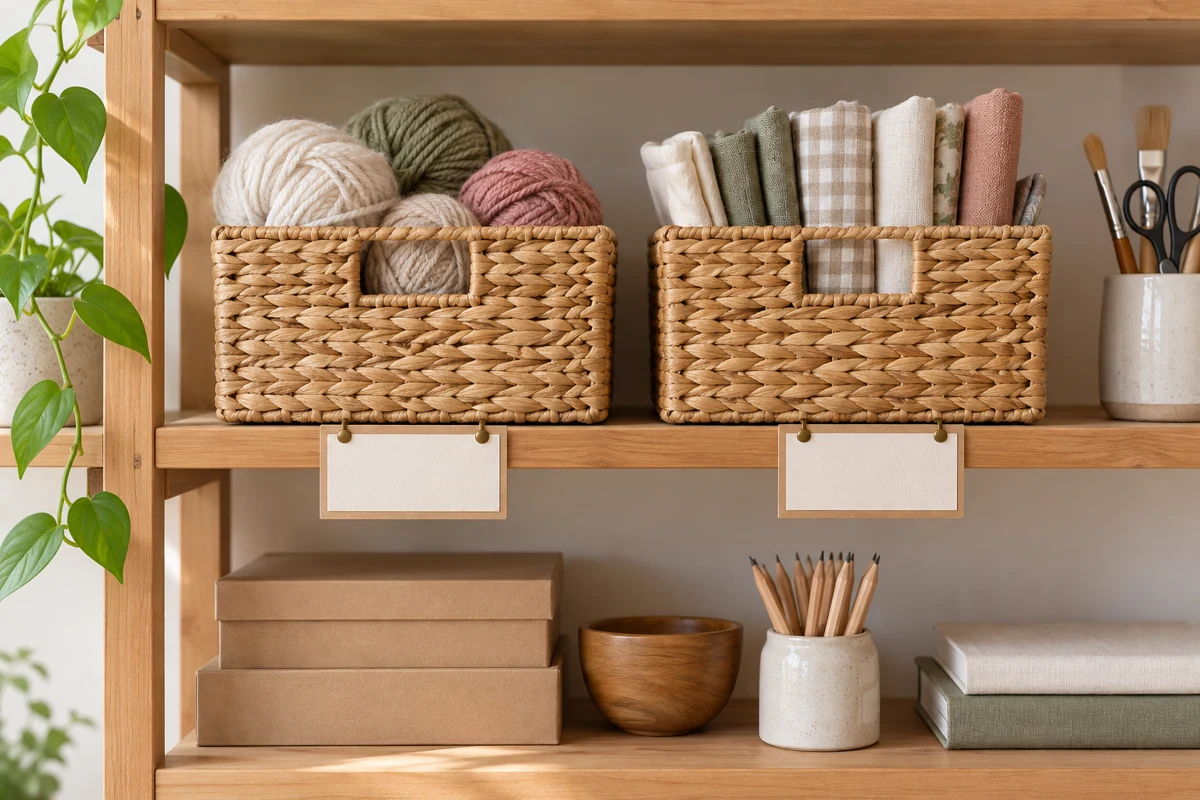
Label the right level
Decide whether a label describes an entire shelf, one box, or a group of supplies. A shelf label should not describe one small container whose contents change frequently. Use short terms other people can understand. “Ribbon” is often clearer than a private abbreviation that may be forgotten in a few weeks.
Write the longest term on a paper strip and place it where the label will go. Check size and contrast from the normal distance. A label below eye level is read differently from one near the floor. Measure the visible edge before cutting a full set of identical cards.
Prefer replaceable cards
A suitable small label holder allows new wording without repeatedly sticking adhesive to the shelf. Use existing label slots on containers where available. If adhesive labels are necessary, check surface compatibility and removal. Unknown glue on finished wood can create more work than the labels save.
Cut cards with enough clearance to fit the holder. An oversized card bows, while an undersized one may fall out. Test one before making the rest. Choose ink that will not smear once dry and inserted. A simple margin usually improves readability more than decorative border lines.
Try a few labels before expanding
Begin with the areas used most often. If nearly every object needs its own sign, the grouping may be too detailed. Combine neighboring categories where doing so still makes items easy to find. Leave some unlabeled space for temporary projects.
After using the system, check that the wording still matches the contents. Replace an inaccurate card instead of sticking another on top. Keep a small template recording type size and card dimensions so additions fit the existing set. Consistency within this shelf is useful; it does not require every drawer in the room to use the same treatment. The purpose is finding things, not filling every edge with text.