Cut a removable drawer liner
A removable liner can be cleaned or replaced without scraping adhesive from the drawer base.
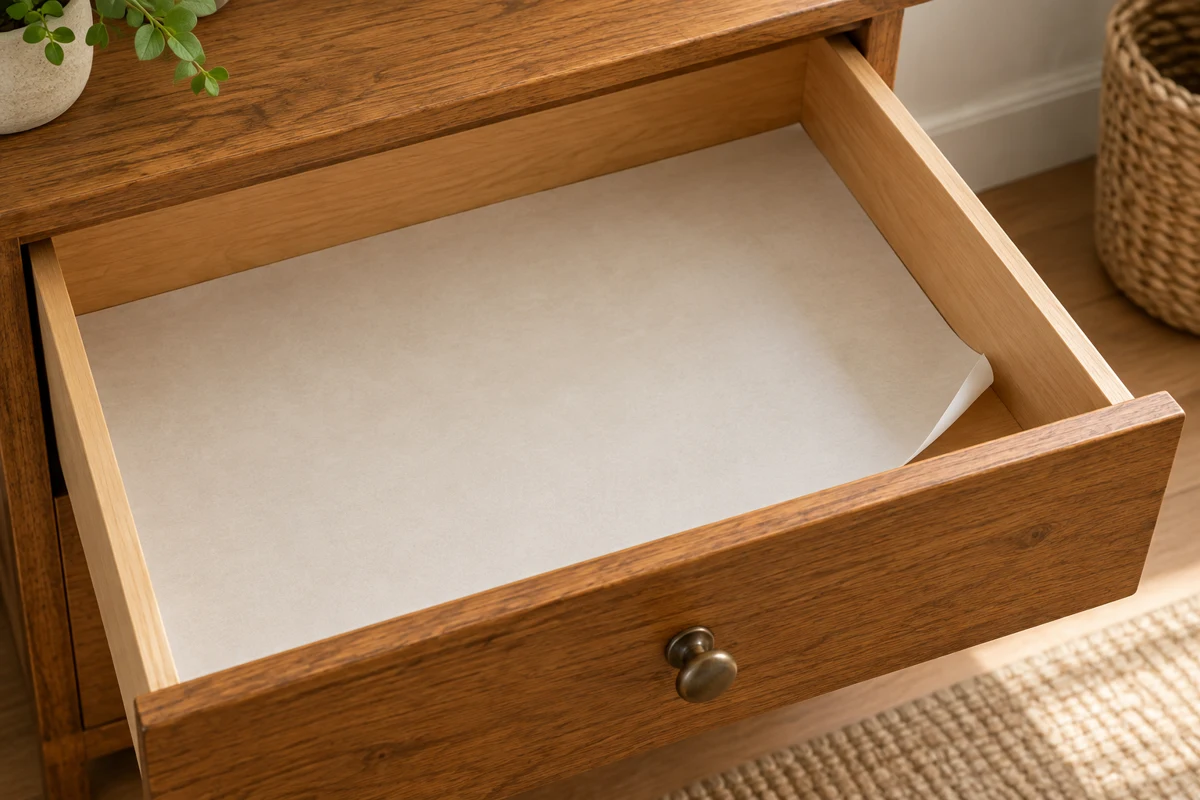
Measure the base in several places
Measure width and depth at the drawer bottom. The opening above may differ, especially with tapered walls or projecting hardware. Compare the front, back, and middle. A paper template reveals whether corners are truly square and whether a small notch is necessary.
Leave slight clearance so the liner fits without buckling. It need not be wedged tightly between the walls. If several paper pieces are required, join them outside the drawer and test the assembled template again. This keeps tape off a delicate interior finish.
If fixed dividers split the drawer, mark the separate areas on the template. Several small liners may be easier to remove than one large piece threaded around permanent partitions. Label their undersides discreetly when the dimensions are almost identical but not interchangeable. This also makes cleaning and replacement less confusing.
Choose for the intended contents
Clean firm card may suit dry lightweight objects. A compatible wipe-clean liner is better when frequent cleaning is expected. Check that the material is suitable for contact with the drawer surface. Sticky, strongly smelling, or unidentified leftover films are poor choices for an enclosed space.
Fabric can soften noise but may snag rough objects and absorb moisture. Unfinished cloth edges do not belong beneath items likely to catch them. Decide whether hemming is required before cutting; those allowances must be added to the intended finished measurements.
Refine the fit gradually
Transfer the template and cut slightly outside the final line if adjustment is still needed. Test the liner and mark only the troublesome areas. Trim in small stages. A large accidental corner cutout cannot be hidden merely by shifting the whole piece.
Check that the loaded drawer opens and closes normally. Keep the liner clear of slides, vents, and moving components. Extra thickness is not necessarily an improvement if it raises objects into the top edge.
Clean beneath it too
Lift the liner periodically to remove dust and crumbs. After moisture appears, dry the drawer and liner separately and fully. A water-resistant-looking top can still trap dampness beneath it. If the liner shifts, reconsider its fit and material before gluing it down. Removability without residue is the main advantage of this approach.