Cut smooth curves from paper
Turn the paper through the cut instead of forcing your wrist to trace every curve.
Make the outline unambiguous
Draw a fine line on the back of the paper. A thick mark leaves uncertainty about whether to cut inside it, outside it or through its center. Choose one side of the line and follow that choice consistently. For repeated shapes, use a firm template that does not bend under the pencil.
Roughly cut around the motif first, leaving some spare paper. A smaller piece is easier to turn than an entire sheet. Do not remove so much that you can only hold the shape by a fragile point, though. Your fingers need a stable area away from the finished cutting edge.
Rotate the paper into the blades
Use calm, overlapping cuts rather than opening the scissors fully each time. Turn the paper with your other hand while keeping the cutting hand comparatively steady. This produces a flowing line without requiring your wrist to keep changing direction. Avoid snapping the blade tips closed at every step, which can leave tiny corners along the curve.
Tight inside curves call for shorter cuts. Large scissors cannot neatly negotiate a tiny radius simply because you squeeze harder. Change to suitable small scissors when needed. If the sheet folds between the blades, check the tool and material thickness instead of pushing the folded section farther into the cut.
Inspect before trimming again
Set the cut shape on a contrasting surface. Small steps are easier to see there than while holding it in the air. Correct only the noticeable spots with a few deliberate cuts. Repeatedly trimming the entire outline can change the shape much more than intended.
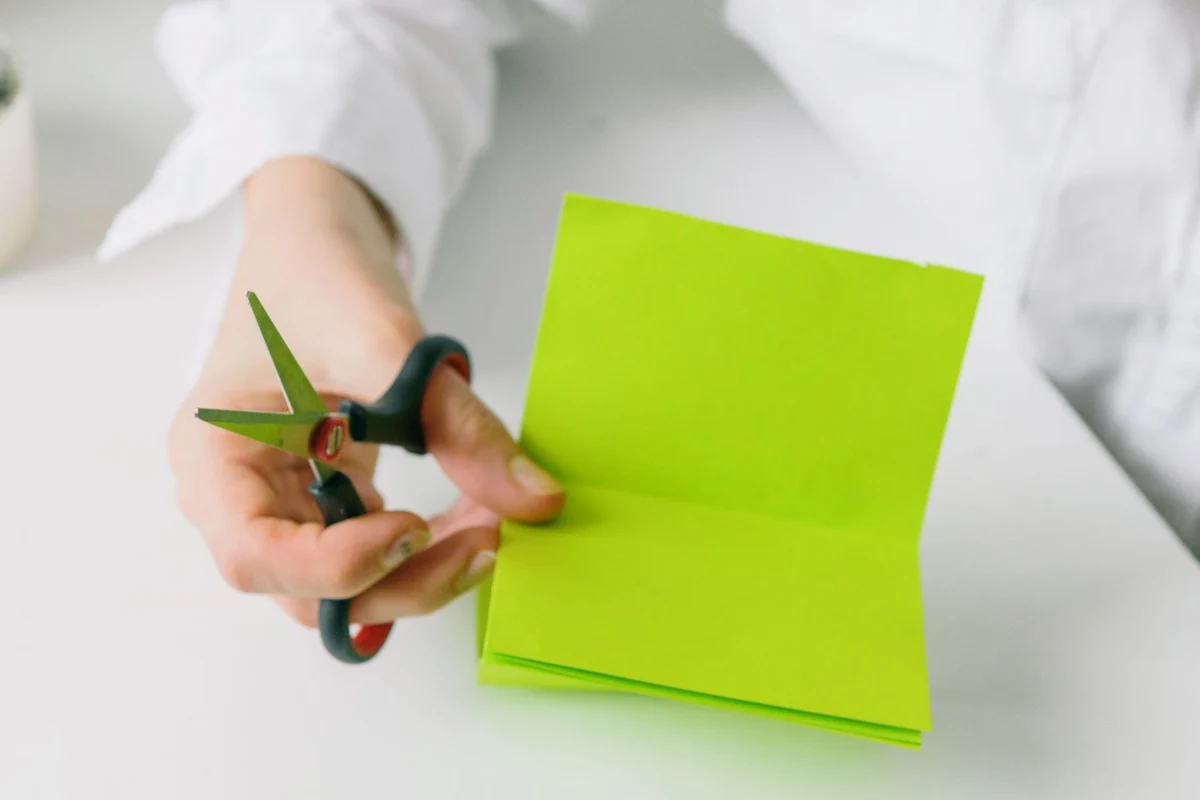
For a symmetrical leaf or heart, folding the paper allows both halves to be cut together. That works only while the layers stay aligned and the scissors can cut them without crushing. With heavier cardstock, a single layer may produce a cleaner edge. Save a successful shape as a template, and label it as such so it does not disappear into the next collage. The reference is most useful while its outline remains untouched.