Make controlled cuts with a craft knife
A stable guide and several shallow passes make precise paper cutting easier to control than one forced cut.
Before the blade touches paper
A craft knife does not need to replace your scissors. It earns its place when you need a straight internal edge or an opening that scissors cannot reach easily. For a simple outer contour, scissors may still be more comfortable. Choose according to the shape and material thickness rather than the tool's appearance.
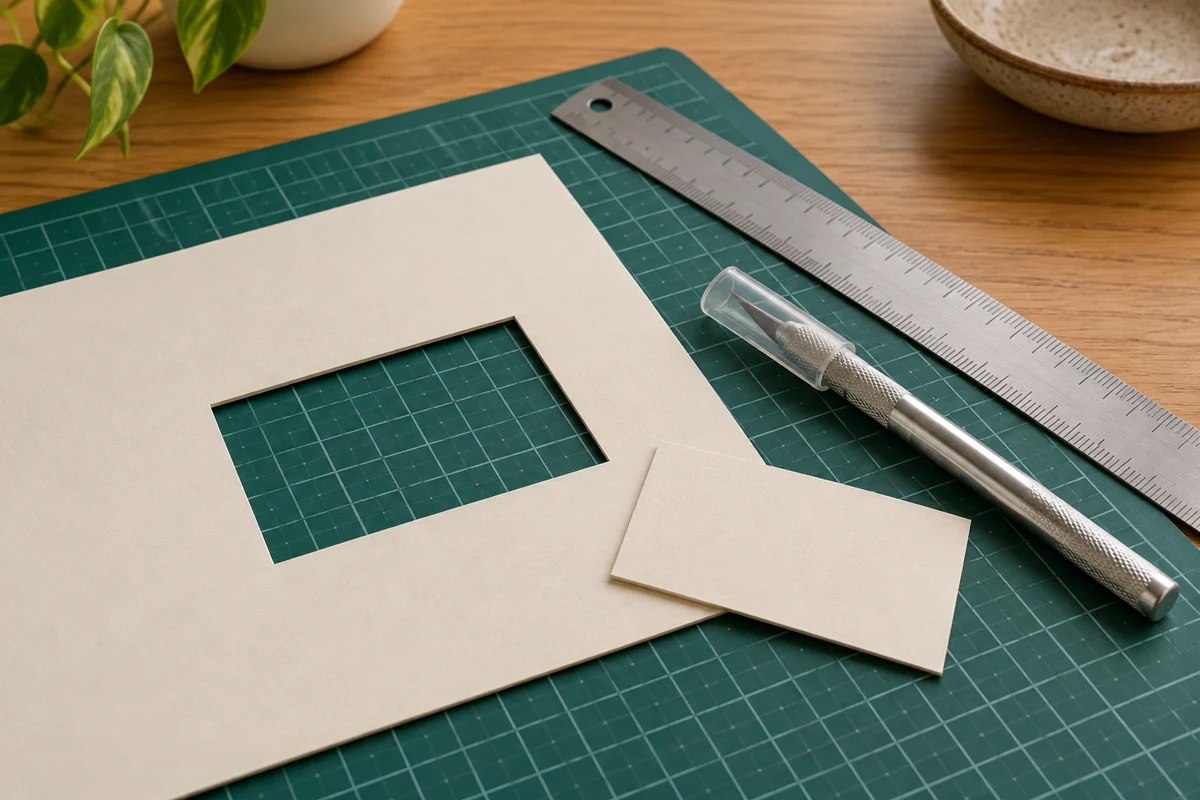
Put a suitable cutting mat beneath the work, fully supported by the table. Clear the entire intended cutting path, including the space beyond the paper. A cup or spare tool should not unexpectedly interrupt the movement.
Check that the blade is secure according to the knife's instructions. A loose holder or damaged tip is a reason to stop. Increasing pressure on a dull blade makes an accurate cut harder to control. Blade changes and storage arrangements depend on the particular model.
Establish a line, then deepen it
Mark the reverse of the material where possible. Place a stable cutting guide along the line. Some thin plastic rulers can themselves be cut by a blade, so do not assume that every measuring ruler is a suitable knife guide. Keep the supporting hand well outside the path.
Make a light first pass to establish the cut. Thicker cardstock may need several controlled passes without moving the guide. Do not try to divide stiff board in one heavily forced stroke. If the stock exceeds what the tool can handle, change the stock or the tool.
Cut away from your body. Rotate the work for a new direction instead of twisting your arm into an awkward position. Practice little internal openings on scrap. The cuts should meet at the corners without extending far beyond the intended shape.
Leave yourself something to hold
Avoid pinning a tiny offcut with fingertips immediately beside the blade. Plan the order of cuts so the piece retains a larger supporting area during the early stages. Separate the last connections only when you can guide the work securely.
Secure the blade before putting the knife down between steps. Loose blades do not belong in an open drawer among paper clips and pencils. Keep replacements in their intended packaging and collect used blades in an appropriate puncture-resistant container.
Inspect the reverse of the cutout before lifting it away. If a few fibers still connect it to the sheet, cut them deliberately instead of tearing the piece free. A small correction usually leaves less damage than a pulled corner. Clear scraps from the mat afterward so they cannot create bumps under the next sheet.