Mitered corners on a rectangular cloth
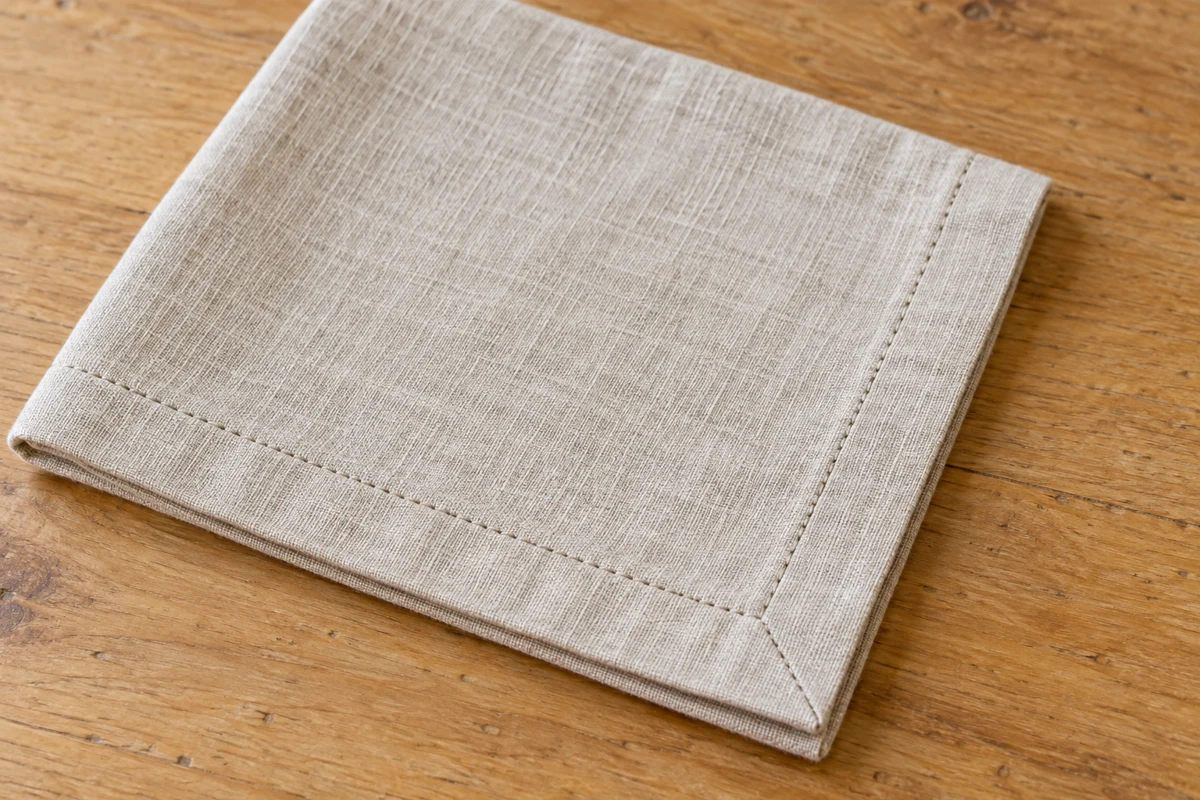
A folded miter spreads the fabric around a corner instead of leaving a bulky stack under the presser foot.
Decide on the hem before forming the corner
Practice on a square of stable, fairly light woven cotton. A 30 cm square with a first turn of 5 mm and a second turn of 15 mm finishes at approximately 26 cm. These are about 11¾ and 10¼ inches respectively; keep the metric hem measurements throughout the sample. The two meeting edges need equal hem widths for their diagonal folds to meet cleanly.
Mark the fold lines on the wrong side with a removable marker tested on a scrap. Press the narrow turn, followed by the wider turn, along both edges. Open only the wider turn again, leaving the narrow raw-edge fold in place. The existing creases show the small area where the corner will form without requiring a new drawing for every fold.
Find the diagonal by refolding
Bring the original fabric point inward on a diagonal. The diagonal crease should pass through the intersection of the two wider hem creases. Refold the side hems to check it: their inside edges should meet on a diagonal while the outside corner stays square. Adjust this fold before removing any fabric.
On a thin practice cloth, leave the folded triangle intact initially. If it creates too much bulk, reopen the corner and trim only the excess that is clearly trapped in repeated layers. Keep enough allowance beneath the diagonal fold to cover the cut edge. Cutting is irreversible; an overly generous allowance can be reduced later, but an exposed corner cannot be made wider again.
Follow the inside edge with the stitching
Return the hems to their pressed positions and pin the diagonal join. Stitch near the inside hem edge. Slow down as you approach the corner and pivot with the needle in the fabric. Avoid pulling across the diagonal grain while steering the work. If the foot tilts over the layers, slower feeding is usually more helpful than tugging harder.
A few small hand stitches can close the folded diagonal if it opens during washing. Catch the folded edges rather than making large visible stitches through the face of the cloth. There is no need to add a thick decorative seam to a miter that already lies flat and stays closed.
Trace an uneven corner back to the folds
A crooked diagonal often starts with unequal hem widths, not the final stitching. Unfold it and measure the two sides again. Likewise, a distorted starting square cannot be corrected merely by folding its corner neatly. Keep a successful practice corner with its folds still visible. It becomes a useful physical reminder of the sequence when you move on to a larger cloth.