Choose cord by construction and use
Twisted, braided, soft or firm: cord construction changes how knots, ends and finished shapes behave.
Handle it before deciding
A cord can look right in a photograph yet feel too stiff for the project. A drawstring needs to travel easily through its casing. A flat coil needs to bend without springing upward. A decorative hanging needs an appropriate end connection. Those jobs ask for different qualities.
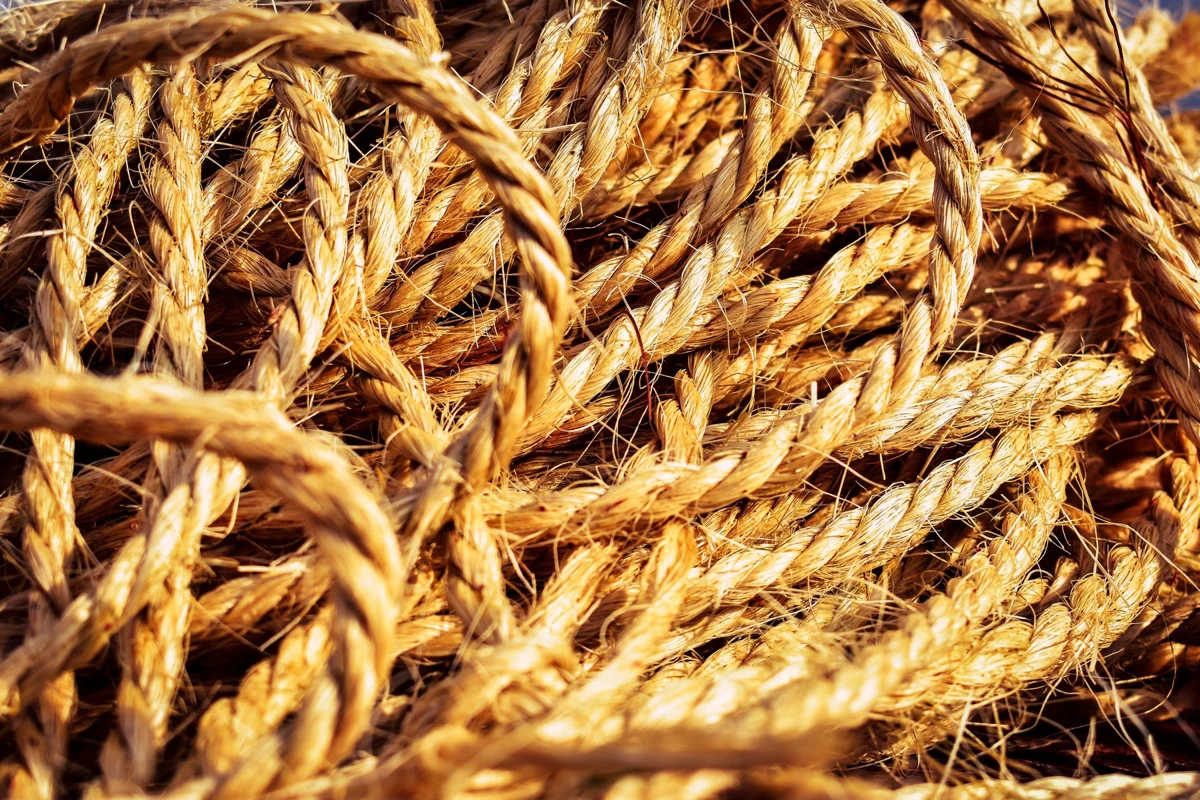
Check construction as well as diameter. Twisted cord contains strands wound together and may unravel at a cut end. Braided cord has a different surface structure and may contain a core. Appearance alone does not reliably identify its fiber composition.
Let a short sample answer the questions
Tie the intended knot in an offcut. Does it tighten neatly or remain bulky and hard? Does ordinary movement loosen it? A knot designed to stop a drawstring passing through a casing has different requirements from one sitting in a flat decorative coil.
Feed the cord through a sample of the actual casing. Allow room for two strands beside each other if the design requires them. A suitable measured diameter is not enough when a rough surface catches at every seam.
For a coiled project, lay several turns without adhesive. They should sit alongside one another without continually lifting. If considerable force is needed to keep the coil flat, the eventual joint will be under unnecessary stress. A softer or thinner cord may suit the shape better.
Plan the ends before cutting
Decide how the cut end will be secured. Depending on the material and use, options include a small whipping, suitable stitching or a purpose-made end fitting. The finish must not become too bulky to pass through the casing if it needs to travel through it later.
Do not apply a flame to unidentified cord. Some fibers melt, others burn, and coatings introduce further uncertainty. A tidy mechanical finish is sufficient for many small projects.
Decorative cord is not automatically appropriate for load-bearing suspension, safety equipment or children's products. Keep long loops away from young children. For an ordinary home accessory, choose a suitable short construction and check it with the intended lightweight contents.
Save the label and a small offcut. Fiber, diameter and handling can then be compared next time, rather than buying a cord that merely looks similar but behaves differently when folded or knotted.