Use hot glue on suitable materials
Hot glue sets quickly, which makes preparation more important. Keep the joint small and check whether the materials suit the method.
Fast setting leaves little adjustment time
Hot glue often gives you only a short interval to align the parts after application. Dry-fit them first. Work out where you can hold each piece without touching the intended glue area. A suitable support or holding aid may be more useful than trying to pinch two tiny objects together with your fingertips.
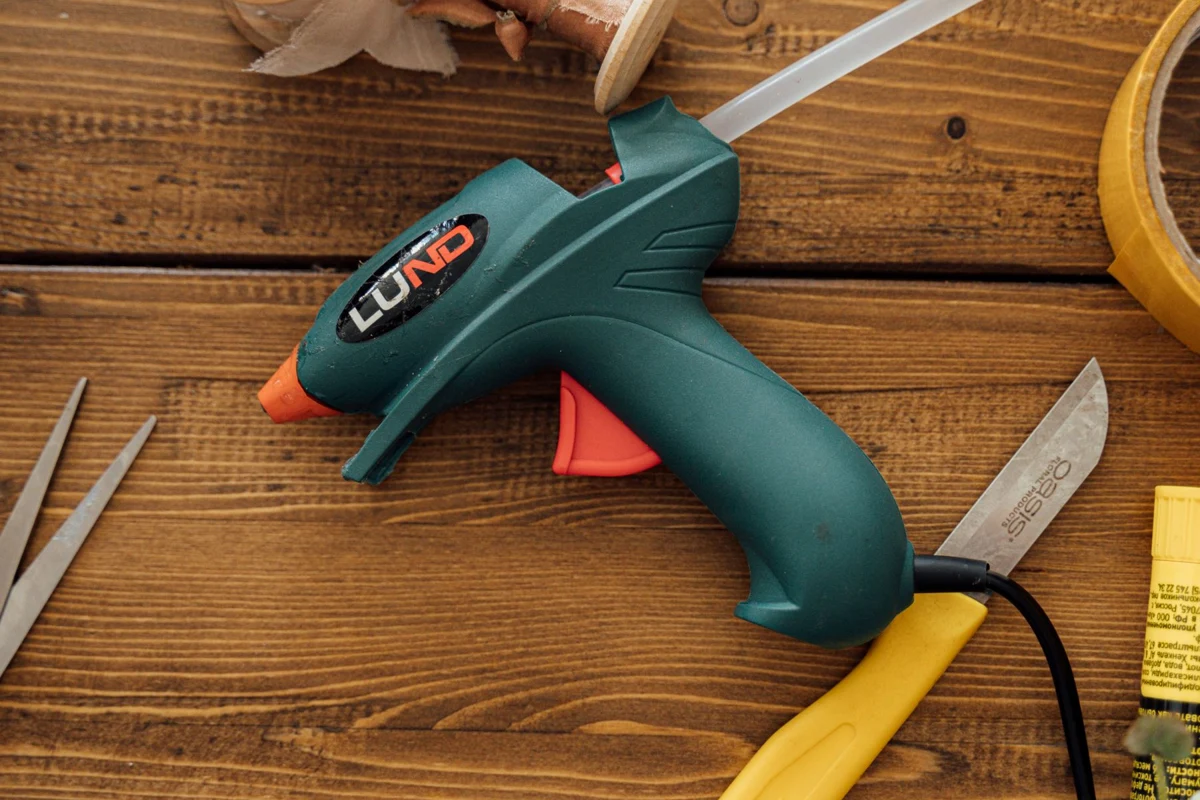
The gun and glue sticks must be compatible. Diameter is not the only specification; temperature range and intended materials matter too. Use combinations approved by the manufacturer. A low-temperature gun is still hot, and its melted adhesive should not be touched.
Give the tool a stable station
Set the gun in its intended stand on a suitable heat-resistant surface. Route the cord away from cutting tools and table edges where it could be caught. Keep loose ribbons, paper piles and fabric scraps away from the hot tip.
Provide an appropriate surface for drips. Do not lay the gun on its side among the materials. Follow the operating instructions for heating, pauses and shutdown. Do not forcibly pull out a partly used stick unless the model's instructions explicitly describe doing so.
Test the actual materials
Use an offcut for the first joint. Heat can distort some thin plastics or foams. Hardened glue may release readily from a very smooth surface. On fabric, a thick dot can form a hard bump visible or noticeable through the front.
Start with a small amount and bring the parts together within the product's working time. Hold them still until the joint has set sufficiently. Do not touch squeezed-out adhesive or try to wipe a hot drip away with a finger.
After cooling, examine the connection in the direction it will be stressed. A decoration may resist sideways movement yet peel off easily when lifted at one corner. That distinction matters for objects that will be handled frequently.
Keep the job within the product's limits
Hot glue is not a universal answer for structural repairs, hot containers, safety-related objects or food-contact items. Any suitability for a particular use needs to come from the product information. Success on an ordinary decoration does not establish it.
Remove stray glue strings carefully after they have cooled. If the gun continually produces heavy strings or uneven amounts, review the temperature, stick compatibility and technique in its instructions. Pressing harder on the trigger does not solve every problem.
Let the tool cool safely after switching it off before putting it away. A small station with a stable stand and proper surface makes future projects easier. It is more useful than starting to heat the gun in the middle of a crowded worktable and deciding where to put it afterward.