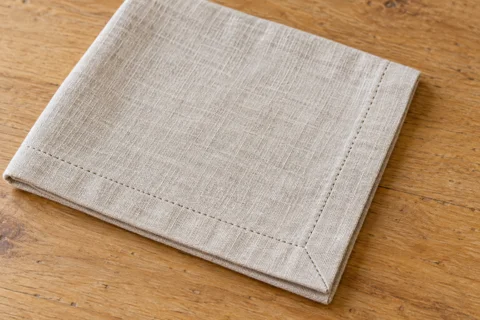
Cloth napkins with a narrow hem
A narrow double hem hides the raw edge while leaving the napkin soft enough to fold.
Start with the size after washing
For a finished napkin about 40 × 40 cm, cut a 44 cm square, approximately 17⅜ inches. Each edge turns inward twice by 1 cm. Use washable cotton or suitable linen, preparing it according to its care instructions before cutting. A small wash sample helps reveal color bleeding or a substantial change in size before you commit the whole piece.
Let the cloth lie relaxed on the table. Pulling one corner to force a square stores up distortion rather than removing it. Check the corners with a square ruler, or measure the diagonals carefully. Follow the woven structure if a printed stripe runs slightly crooked. A visually straight print is not always a dependable guide to the actual fabric grain.
Keep a small set consistent
Once the first napkin washes well, prepare the remaining squares. Check each cut instead of using a crooked first edge as the reference for every following piece. With stripes or checks, settle the visible direction before hemming. Small differences are more noticeable along a table edge than in a folded stack.
For a set, press all first turns and then all second turns so the gauge stays consistent. However, do not sew the entire batch without a sample if the machine setup has changed. A short scrap seam checks tension and stitch length. Stack completed napkins loosely so warm folds can cool rather than pressing them immediately into a crowded drawer.
Let the folds establish the hem
Press a 1 cm turn along all four edges, then fold each edge inward by another centimeter. A seam gauge helps keep this width consistent. Work around the corners deliberately instead of trying to press the entire perimeter in one hurried pass. Keep fingers away from the iron while holding a neighboring fold in position.
With this narrow hem, the corners can overlap simply. Arrange the folded layers so that no raw edge escapes at the point. Heavy fabric may become bulky here; choose a thinner cloth or a wider mitered hem if the stack will not lie comfortably. Do not cut large triangles away in advance, since the narrow fold needs enough fabric to contain the corner.
Stitch, then use one before making a set
Sew close to the inner folded edge. At a corner, stop with the needle down, lift the foot, turn the work, lower the foot, and continue. Remove pins before sewing over their positions. Beginning on a straight side rather than at the thickest corner helps the feed dogs move the fabric evenly from the first stitches.
Trim loose threads and press the finished hem. Wash this single napkin before cutting a full table set. After drying, see whether the corners curl or the stitching draws the surface into little ripples. An overly tight thread setting or unsuitable care routine is much easier to change after one napkin than after a dozen. Record the fabric, cutting size, and washing method that worked together. Those details are more useful for repeating the result than the intended finished measurement alone.