A small air-dry clay catchall
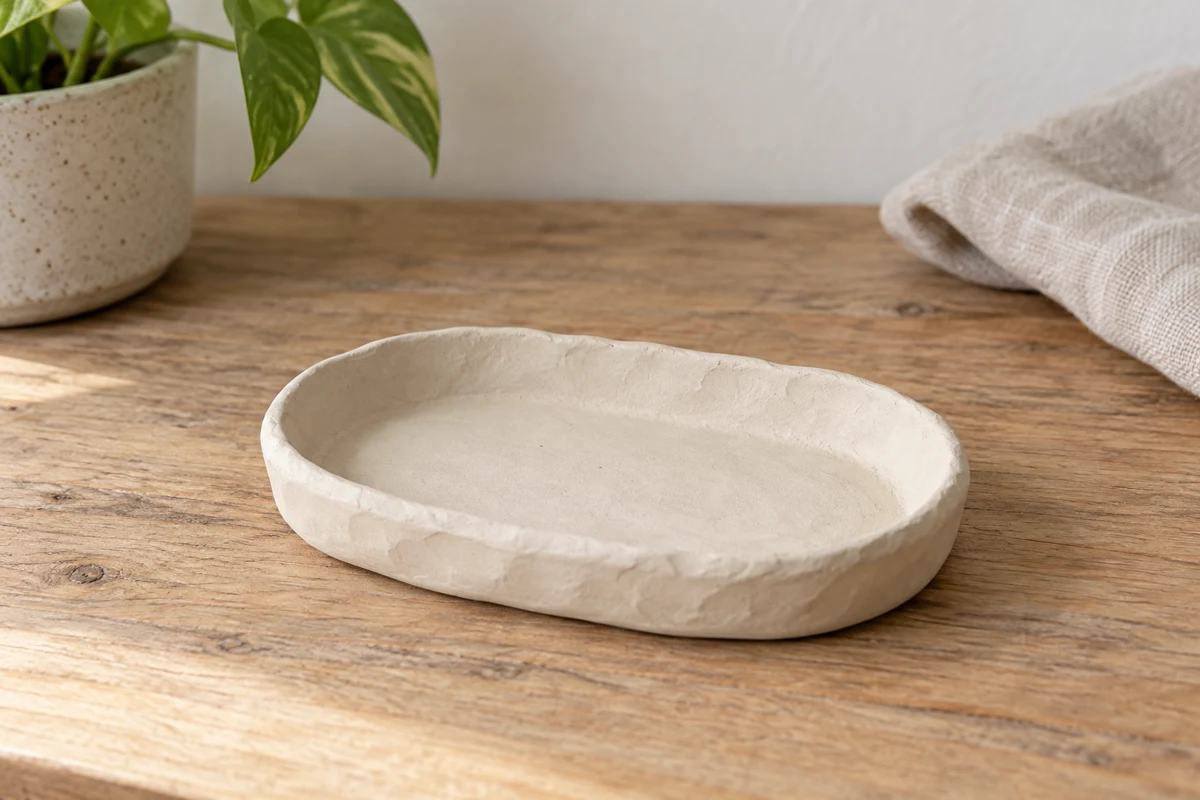
A shallow air-dry clay dish holds dry small objects. Its rim can remain simple and low.
Decide what the dish will hold
Plan it for rings, paper clips, or other dry objects. Air-dry craft clay is not fired ceramic. Crayola explicitly excludes unpackaged food, heat, and open flames from the intended uses of its material. Adding varnish does not automatically make a piece food-safe or waterproof.
Choose a clay with clear handling and drying instructions. Set out a suitable smooth work surface, a rolling tool, two equal-thickness guides, and a blunt modeling tool. Keep the package closed while working with a small portion. An entire exposed block can develop a dry skin long before a small project uses it up.
Roll an even slab
Condition the portion briefly as its maker directs. Roll it between the guides to about 5 or 6 mm thick if that thickness is suitable for the product. Lift or rotate the slab gently from time to time so it does not stick firmly to the surface. Adding a lot of water is not a dependable solution to stickiness and may complicate drying.
Cut a simple circle or oval using a paper template, perhaps about 12 cm across, just under 5 inches. This is a suggested size for a small catchall, not a rule for every dish. Larger pieces need their own assessment of thickness and drying behavior. Smooth the cut edge with lightly damp fingers without stretching it into a thin, fragile lip.
Raise the edge only slightly
Lift the outside area evenly while leaving the center flat. A rim around 1 cm high is enough to stop little objects rolling straight off. Work gradually around the perimeter. Pulling one area upward sharply thins the slab there and can create a weak point as it dries.
A shallow form with a suitable separating layer can offer temporary support. However, the clay should not grip a rigid mold so tightly that shrinking is restricted. Follow the material instructions and release it once it can support its shape. Do not return kitchenware to food use if craft material or unidentified residue has contaminated it.
Give the base time to dry
Dry the piece under the conditions specified for the product. Once it is firm enough to move safely, arrange for air to reach the underside too. Do not speed the process on a heater or in an oven unless the manufacturer expressly allows that method. Ordinary air-dry clay is intended to dry at room conditions.
A surface may feel dry while moisture remains inside the base. Consider color, firmness, and the stated minimum drying period together. A thick area takes longer than a thin rim. Wait for complete drying before painting. Crayola's decorating guidance permits paint on thoroughly dried pieces; meeting that condition matters more than planning to finish at a particular hour the next morning.
Make a companion sample
Use a leftover portion to form a small flat sample at the same thickness as the dish base. Place it beside the project and note which face rested on the support. Later, test paint or a finish there before committing to the dish. It cannot prove that the thickest part of the dish is dry, but it provides a useful comparison for surface behavior and color.
If giving the dish away, decide while shaping it what it should hold. One ring needs less room than a key ring with angular attachments. For frequently dropped keys, an existing robust container may be a better choice; modeling clay is more appropriate for gently handled decorative objects. An appealing shape does not have to withstand every daily use.
Keep the clay and paint instructions so the eventual cleaning method remains clear. A brief note such as “for dry small objects; do not soak” is more useful to a recipient than an unsupported durability claim. The actual product directions take priority over general crafting habits.
Handle the finished object as a craft piece
Inspect the underside for rough particles before placing it on furniture. Small soft protective pads may help if they adhere properly and keep the dish level. Avoid pressing hard on the rim. Clean it dry, or only as expressly permitted by both the clay and its finish. Choose a different suitable container for wet bathroom items, plant water, or hot cups.