Take an old shirt apart for usable fabric
An old shirt provides several different fabric areas, and their useful sizes emerge only after inspection.
Keep a wearable shirt wearable
Before cutting, consider whether a small repair would return the garment to use. A missing button or open side seam does not require dismantling an otherwise sound shirt. This project suits one that is no longer useful as clothing but still contains firm fabric.
Wash according to its care label and dry completely. Inspect the collar, cuffs, underarms and central back against the light. These areas may be more worn than the sides. Record unsuitable spots with a note or a removable fabric-safe mark rather than a permanent pen across a usable panel.
Secure the large panels first
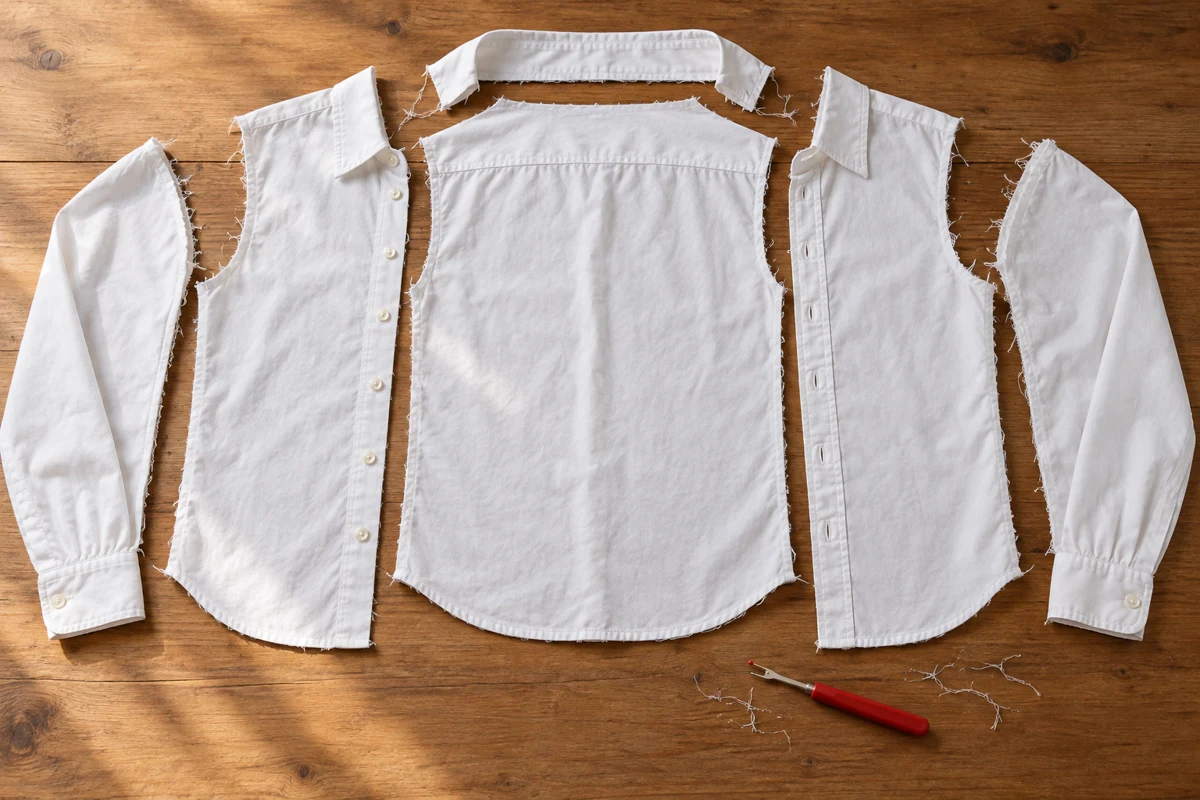
Lay the shirt flat. The back is often its largest continuous area. If every fraction of an inch is not needed, cut just beside the side and upper shoulder seams. This is quicker and may be gentler on thin fabric than prolonged unpicking. If the full width matters, release those seams patiently with a seam ripper instead.
The fronts contain button bands and possibly pockets. Decide whether those finished details could serve another project before cutting. A button band can remain a ready-made closure, but it needs fabric beside it. Do not immediately reduce it to a narrow strip. Remove buttons intended for separate storage without cutting into surrounding usable cloth.
Assess sleeves and reinforced parts separately
Opening a sleeve's long seam usually reveals a useful elongated panel. Remove cuffs and badly worn elbow areas unless they are deliberately part of the new design. The panel is not a rectangle, so place proposed pattern pieces on it before trimming away more fabric.
Collars and cuffs often contain interfacing that changes their thickness and pressing behavior. They are not equivalent to a single layer of shirt fabric. Keep them only when you have a plausible use. Hard seams and old reinforcement may complicate a delicate project more than they help it.
Label what you recovered
Spread the salvaged panels out and record known fiber content and care instructions. Photograph or copy the original label before discarding the remaining garment. Note color differences too: fabric beneath a pocket can be darker than the exposed area around it.
A test seam helps reveal whether the cloth can still support new stitching. Pull gently across the sample and watch for enlarging needle holes. Many shirt fabrics suit light linings, small bags or patchwork, but are less suitable for heavily loaded handles. Available dimensions are only one part of the decision. Strength and behavior matter just as much when choosing the next project.