A reusable stencil from cardstock
A cardstock stencil lasts longer when its bridges stay intact and paint stays off the underside.
Think in openings
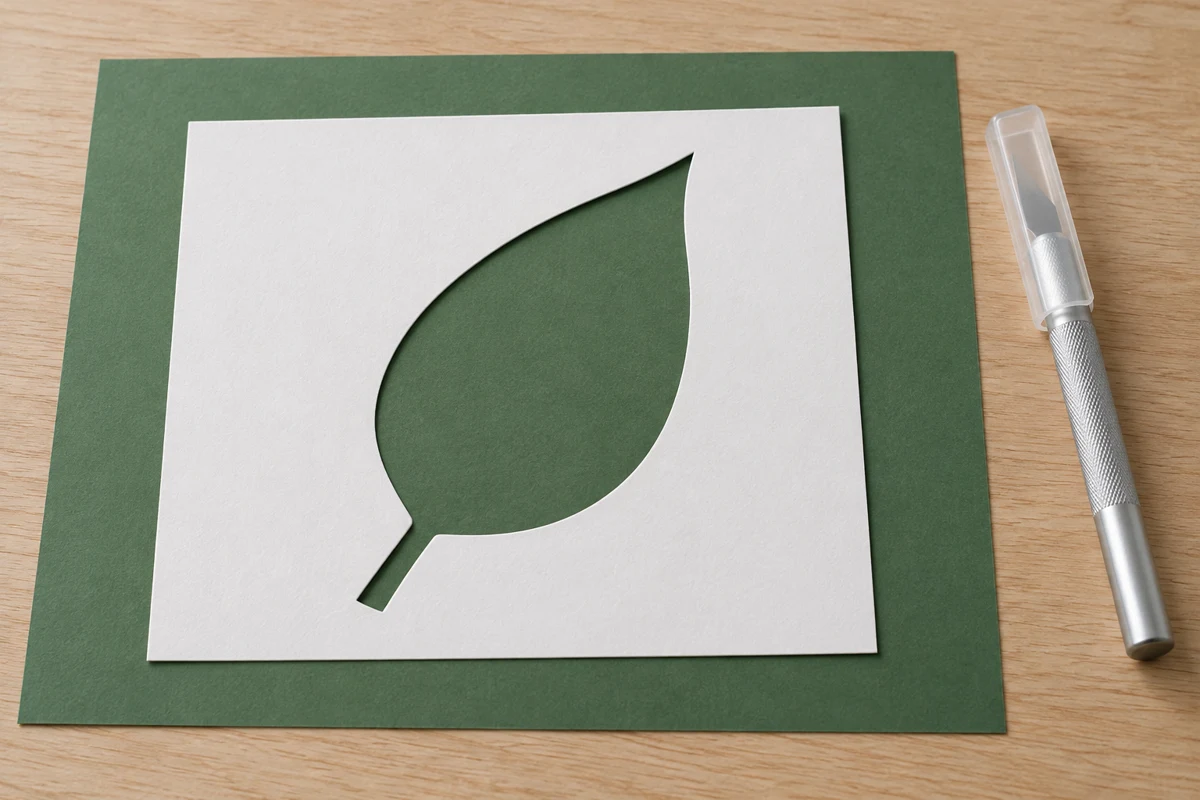
Draw a simple motif on smooth, firm cardstock. A leaf, circle or broad letter is easier for a first attempt than many fine lines. The areas you remove become the painted shape. Any island inside the design must remain connected to the surrounding sheet or it will fall out.
A letter with an enclosed center therefore needs small bridges. Make them wide enough to resist bending under a brush. You can fill those interruptions afterward with a fine brush, but you do not have to; they are part of a stencil's familiar appearance. Leave a generous border around the design for holding or taping it down.
Cut with control
Place the card on a cutting mat. For straight sections, use a suitable ruler and craft knife with several light passes rather than one forceful cut. Keep your free hand outside the cutting path. Small curves may be easier with fine scissors once you have an opening inside the waste area.
Remove loose fibers without gradually enlarging the entire outline. Lay the stencil on a scrap surface and check that its bridges lie flat. Warped cardstock lets paint creep underneath. For very fine detail or repeated wet use, a purpose-made stencil sheet is a better choice than simply using thicker cardboard.
Apply less paint than you expect
Secure the stencil so it cannot slide. Load a sponge or brush lightly, then dab excess paint onto scrap material. Work downward rather than pushing sideways against the cut edge. A wet brush can force color underneath even a carefully cut stencil.
Lift the stencil straight up and set it aside to dry. Do not scrub a damp cardboard stencil with water, which can make it swell and distort. Remove loose dry paint gently if needed. Replace the stencil when its edges soften or its bridges break. Keep your original drawing as a master so the next version is not traced from an already distorted piece. A clean outline and restrained paint application matter more than making the first stencil last indefinitely.