Sort old buttons by possible use
Sorting buttons by function makes useful replacements easier to find than color sorting alone.
Compare more than the color
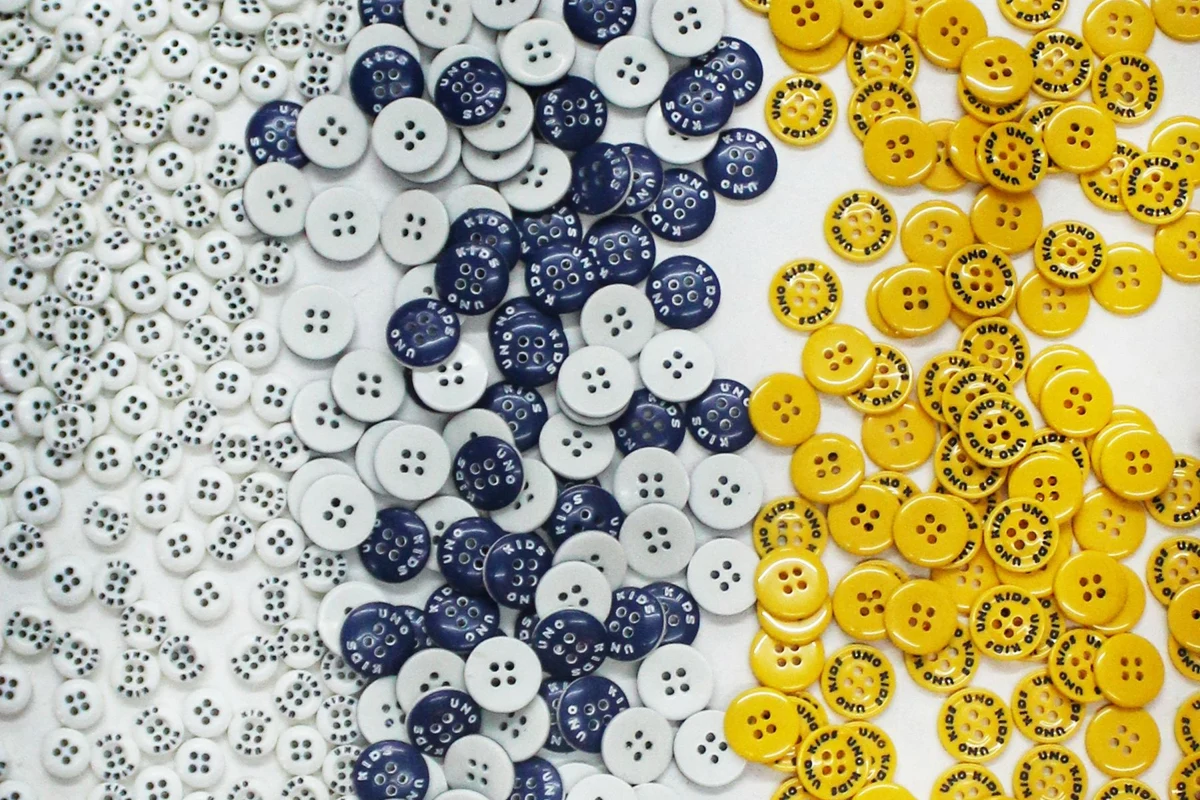
Spread the buttons on a light surface. Separate flat two-hole and four-hole buttons from shank buttons with a loop behind them. Their attachment and distance from the fabric differ, so two similar-looking buttons are not automatically equivalent replacements.
Inspect each for cracks, broken edges and damaged holes. Remove old thread carefully. A beautiful button with a broken shank is unsuitable for a working closure. It may have a purely decorative use only if its edges are safe and the new attachment is appropriate.
Keep useful sets together
Place identical or compatible buttons in groups. Count them and record diameter and quantity. For repairs, several matching buttons are often more useful than a perfect color sequence. Label a spare belonging to a garment you still wear with that garment's name.
Small envelopes or shallow compartments keep sets separate. Avoid pulling them tightly onto thin wire that can damage holes or scratch your hand. Loose thread can hold some groups together if it remains easy to undo. Keep small pieces out of young children's reach.
Try a replacement on the garment
Before sewing, pass the proposed button through the existing buttonhole. Diameter is not the only consideration; thickness and curvature also affect fit. It should hold securely without stretching the opening every time it closes. With a shank button, check whether the extra distance from the fabric is wanted.
Store only clean, dry buttons. Do not soak unidentified delicate materials together or treat them with aggressive cleaners. If the collection becomes unwieldy, remove unusable singles rather than building ever-finer subdivisions. The organization should make a repair easier, not preserve a complete record of every decorative object once attached to clothing. A small set of relevant spares can be more useful than a large jar that must be emptied for every search.
On a garment with several buttons, one replacement can deliberately look different if its size and function work. For a uniform row, compare the whole set in daylight. Similar shades may look identical under a warm lamp and differ clearly later. Rest the buttons on the fabric too: a strongly domed shape stands differently from a flat one. This quick trial prevents an apparently well-matched stored set from proving unsuitable only after it has been sewn on.