Plan small gift pouches in several sizes
Size a gift pouch around the object's widest part and its closure space, not just the object's height.
A flat outline misses depth
A rectangular object can fit on a flat fabric piece yet fail to fit the pouch made from it. Depth is often the missing dimension: the fabric must travel around the sides. A two-dimensional outline does not account for that.
Wrap a paper strip loosely around the object's widest circumference. It should meet without compressing the contents. That measurement provides a starting point for the pouch circumference, with ease and seam allowances still to add. For an irregular object, a complete paper mock-up is more useful than one formula.
Allow empty fabric above the contents for closing. A drawstring casing, an external bow and a folded top each use different amounts of space. A closure sitting directly against the gift's top edge is often awkward to operate.
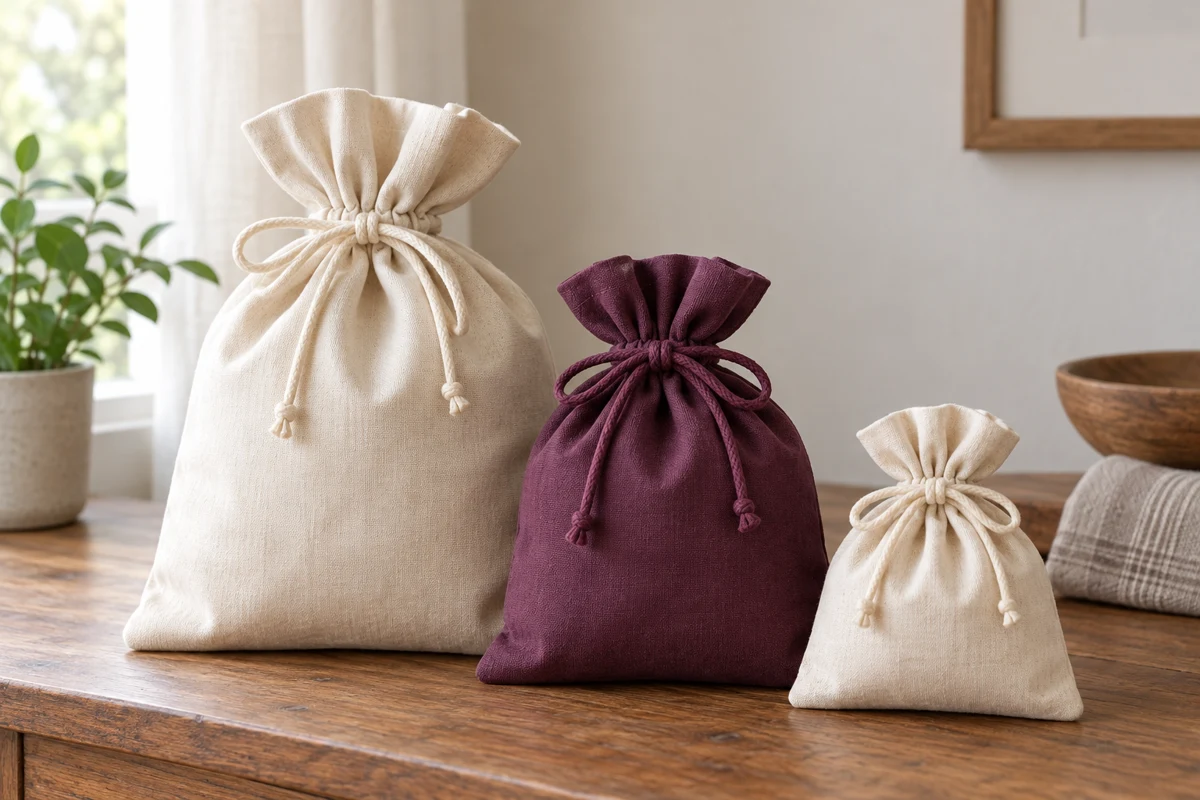
Base three sizes on three real examples
Rather than sketching small, medium and large entirely by eye, choose three typical objects. Make a trial pouch for each from inexpensive scraps. Insert, remove and close the contents several times. A bag should do more than accept a gift once with considerable patience.
Record finished width and height alongside the original cutting dimensions. State whether allowances are included. Note whether the design is flat without a boxed base; adding one later changes the available interior.
Fabric handling matters across a mixed-scrap set. Stiff cloth needs more room in a knot than soft cloth. Thin material may show the contents and behave differently under their weight. Check the material as well as the measurements.
Connect the set without matching everything
A repeated ribbon color or hem treatment can link the sizes. Every surface does not need another decoration. Extra layers quickly occupy significant space on a small pouch.
Label the tested templates clearly and keep them apart from unproven sketches. Cut a new batch from the current master, not from an old finished bag whose seams conceal its original dimensions.
Delicate or sharp-edged contents need suitable inner protection. A fabric pouch is not cushioning and is not a safe sheath for an exposed blade. Food also needs appropriate separate packaging.
Use a closure that can be undone without destroying the pouch. A removable card and releasable tie make the wrapping useful for other small objects afterward. The most useful size is often one that can find a second job after the first gift has been opened.