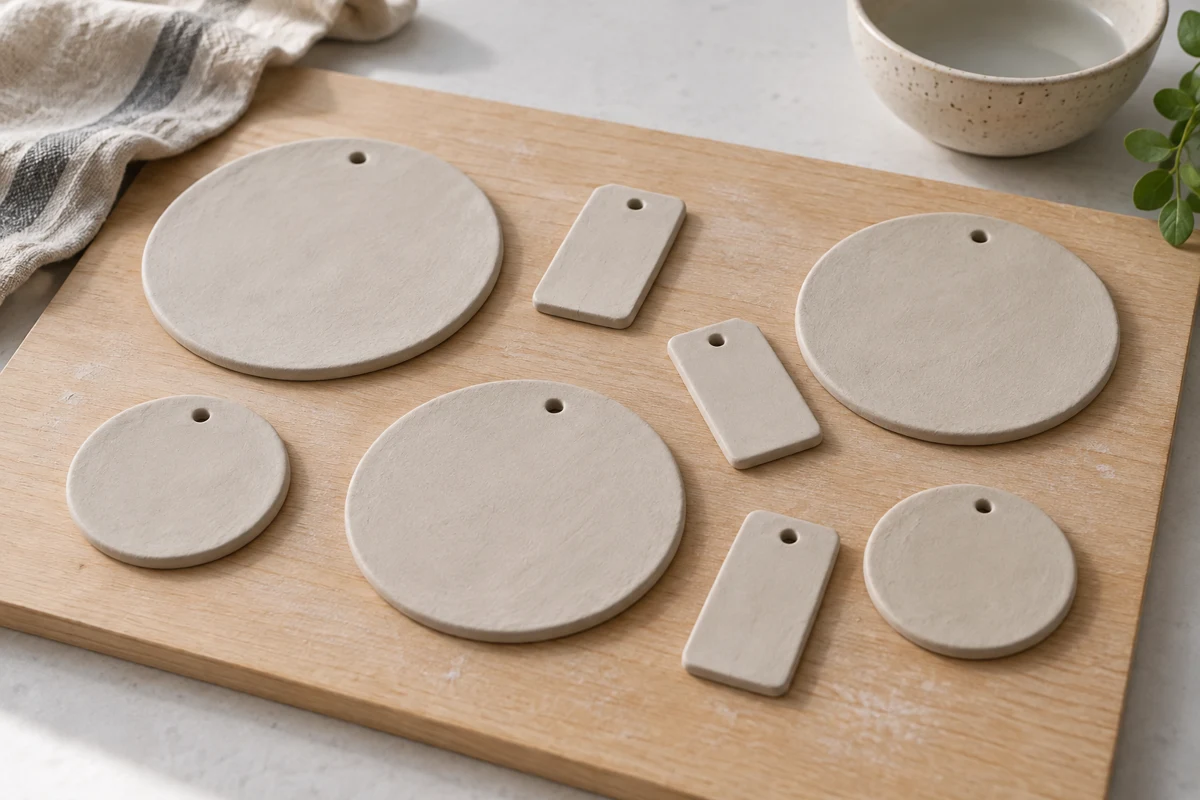
Dry flat air-dry clay pieces
A dry surface does not necessarily mean a dry center. Flat pieces need reasonably even conditions on both faces.
Include thickness in the drying plan
Check the material's instructions for minimum thickness, drying time, and suitable surroundings. Two pieces of similar width may take different amounts of time if one has a thick rim or an extra layer. Note the approximate thickness with the starting date. A time alone is not very useful when you later want to repeat the result.
Roll flat pieces as evenly as possible. A thin corner beside a thick center dries differently and may distort. Small variations are normal, but a pronounced thickness change should be corrected while the clay remains workable. Do not casually add a wet layer to a partly dried surface without following the product's joining instructions.
Remember the underside
Set the work on a clean appropriate surface. Once it is firm enough to move without distortion, allow air to reach underneath too. Depending on the product and shape, careful turning or changing the support may help. Lifting a soft piece by two corners can permanently bend it.
An oven, hair dryer, or radiator is not a universal shortcut. Use accelerated methods only if the manufacturer explicitly permits them. Strong local heat can alter the surface while moisture remains inside. A stable room location is easier to control than a sunny windowsill whose temperature changes sharply during the day.
Assess the piece, not just the calendar
Look for the drying indicators described for your material. Consistent color and firmness can help, but products differ. If the underside still feels unlike the top, allow more time. Do not coat it merely because a planned crafting session is ending.
Space multiple pieces apart and label their supports so an older piece is not confused with a newly formed one. Complete drying should precede painting or gluing. If a piece remains noticeably warped, do not force it flat beneath a heavy weight; dry clay may break. More even thickness and better underside airflow are more useful changes for the next sample. A small irregular edge can remain on a decorative piece if it creates no sharp or loose area.