Use old calendar pages as wrapping
Large calendar pages can become wrapping when you account for image direction, old holes and paper stiffness.
Find the usable area
Release the page from its binding carefully, removing metal parts completely. Inspect the top for small tears; the area around punched holes is often weakened. Trim it away if needed before measuring the remaining sheet. A large calendar does not necessarily provide an equally large sound rectangle.
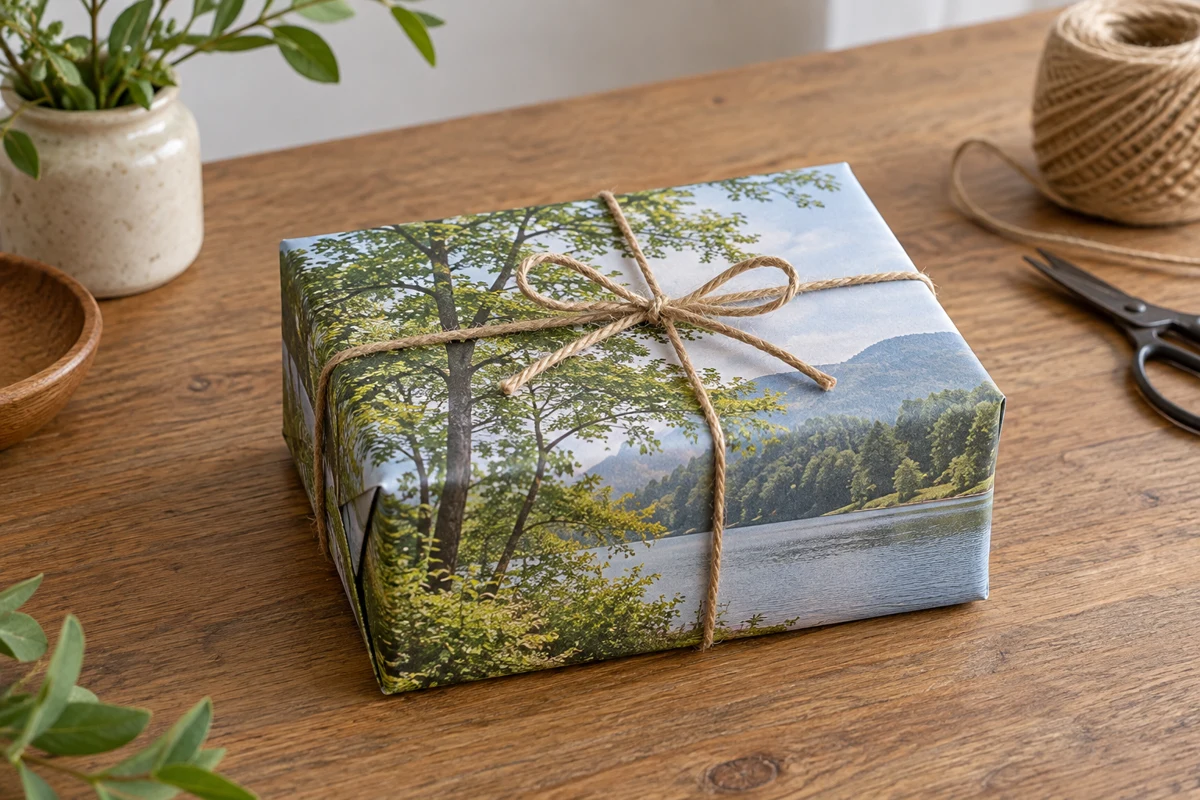
Lay the page around the gift without creasing it yet. Check the visible image crop and the position of dates or lettering. A picture may work well on a flat box but break into confusing fragments around a small round object. Choose a wrapping shape that suits the available sheet.
Give stiff paper controlled folds
Many calendar pages are heavier than ordinary gift wrap. Mark the parcel edges, then remove the paper to pre-fold them. Light scoring with a blunt tool may help. Test on a scrap, especially with a glossy coating that can crack along a crease.
Keep overlaps fairly modest so the ends do not contain too many layers. Adhesive or tape must grip the coated surface reliably; try a separate joint first. Paper that springs open strongly may need another folding approach rather than more strips of tape.
Let some earlier use remain visible
An old hole can deliberately hold a tag if its surrounding paper is still sound, but keep it away from a stressed wrapper corner. Small date markings on the reverse may be perfectly acceptable for a personal gift. There is no need to cover every trace of the page's earlier purpose.
Calendar paper is not automatically suitable for direct food contact. Use it only outside an appropriate inner package. Published or sold designs also need to respect rights in other people's photographs and illustrations; an old calendar does not make them free to reuse. Save a few large, foldable pages rather than several entire calendars. A small supply with known dimensions is easier to turn into an actual project.